
The hidden cost of inefficiency in most small businesses is not a single bad decision or a problem you can point to on a spreadsheet.
It is five minutes here and twenty minutes there, jobs that take longer than they should, the same problems surfacing week after week, and a visibly busy team, but somehow never quite on top of it.
You can feel the drain even when you cannot locate it. And until you put a number on it, it stays invisible.
Why the waste in your business is almost impossible to see
The waste that costs small businesses the most is not dramatic.
It’s not a catastrophic mistake, a dodgy supplier, or a month when sales fell off a cliff.
It’s five minutes here and twenty minutes there. A job that needed three sign-offs when one would do.
A question that had to go to the same person every time because the answer lived only in their head.
A mistake that was quietly fixed, then resurfaced three weeks later.
None of those feels worth raising. Nobody flags a five-minute delay.
Nobody raises a hand to say they spent half an hour hunting for a file that should have been in one place. So the friction survives, unchallenged, year after year.
Here is the maths that tends to change perspective.
Five minutes of avoidable delay, happening twenty times a day, across a team of eight people, over fifty working weeks: that is over 330 hours of capacity gone.
Not spent on something wrong and gone. And in most businesses, that kind of friction is running in a dozen places at once.
The eight places your time and money disappear
This pattern was first mapped inside Toyota and has since been applied in organisations of every size and type.
The specific terminology varies depending on who teaches it, but the categories are consistent.
Once you know what you’re looking for, you start seeing it everywhere.
Waiting. People or work are sitting idle because something upstream has not happened yet. A quote waiting for a manager who is in back-to-back meetings. A job paused because a part has not arrived. An email chain that has gone back and forth four times when a five-minute conversation would have resolved it on the first pass.
Rework. Doing the same task twice because it was not right the first time. Correcting invoices. Re-entering data that came in incorrectly. Sending something back because it was checked after it should have been, not before.
Unnecessary steps. Work that gets done because it has always been done, not because it adds anything. Reports nobody reads. Approval processes for decisions that do not need approval. Meetings that exist out of habit rather than necessity.
Mistakes and defects. Errors that reach the customer, or that are caught internally but still need to be fixed. The real question is never just how to correct the mistake. It is why the process allowed it to happen in the first place.
Overproduction. Making, processing, or preparing more than is needed right now. Ordering stock in bulk because the unit price is lower than spending money storing it. Writing detailed proposals for prospects who have not given any real commitment.
Excess movement. People are moving more than necessary to do their work. In a physical environment, that is often literal. In an office or a service business, it shows up as switching between systems, hunting across shared drives, or managing information scattered across email, WhatsApp, and three different spreadsheets.
Holding too much in progress. Backlogs and queues. Work that piles up between stages while nothing is actively happening to it. Jobs that are technically started but not moving.
Skills going unused. People with knowledge and capability that the business is not drawing on. This is often the quietest waste of all. The team member who can see a better way but has never been asked. The experienced hire is doing work well below what they are capable of.
What this looks like in a real business
Take a small professional services firm: an accountancy practice, a legal office, a consultancy with twelve people. On the surface, everything looks fine.
Clients are being served, invoices are going out, and the team appears busy.
Look more closely at how work actually moves.
Client files go to a partner for review before they go out.
The partner is often in meetings. Files wait. Sometimes for hours, sometimes for a full working day.
The work itself is done. It is just sitting, extending delivery times, and quietly building stress across the team.
A junior team member has a question about how a particular type of return should be handled.
The answer lives in one person’s head. They ask. That person is busy.
They wait, or they take a guess, and sometimes the guess is wrong.
That is waiting waste, motion waste, and the rework that usually follows, all from a single question that should have had a documented answer.
Multiply that across a week, across the team, across the year.
No one person is at fault. The processes were never designed.
They grew up around whoever was available and whatever worked at the time.
That is how most small-business processes are built, and it is precisely why they contain so much avoidable friction.
How to start finding it in your business
You do not need a consultant to begin. You do not need a methodology, a software tool, or a day of training.
You need to look at how work actually moves through your business, not how you believe it moves.
Start with one process. Not the whole business. Pick one thing you do repeatedly: a customer order, a project kick-off, an invoicing run, a job handover from one person to the next.
Pick the one that feels most friction-heavy, or the one that matters most to get right.
Then ask these three questions about every step:
- Does this step add something the customer would recognise as valuable, or does it exist for internal reasons only?
- What happens when this step goes wrong?
- How long does this step actually take, compared to how long it should take?
Those three questions will surface the waste faster than any formal audit.
The answers will be uncomfortable in places, but they will also tell you exactly where to focus.
The objection worth addressing now
A common reaction at this point is: “This sounds useful for a big company, but we’re too small for it to make much difference.” That assumption is worth testing directly.
Process waste does not scale with headcount.
A business of ten people can lose just as high a proportion of its capacity to friction as a business of a thousand.
The mechanisms are smaller, but the proportional cost is not. If anything, in a small team, every hour matters more because there is no slack to absorb it.
The number most business owners have never calculated
Here is a calculation worth running before you do anything else.
Take the number of people in your team. Multiply by the real hourly cost of employing them, not just salary but employer contributions, benefits, and overheads.
Then estimate how much time per person per day is genuinely lost to friction: waiting, rework, unnecessary steps, chasing information that should already be findable.
A conservative estimate of thirty minutes per person per day, across a team of ten people at an average employment cost of £20 per hour, comes to £50,000 a year in wasted capacity.
Not spent on something wrong. Just lost, spread across hundreds of small moments that never felt worth measuring individually.
Most businesses have never done this calculation.
Not because they do not care about the answer, but because the waste is invisible. It does not appear on a single line in your financials.
It hides in the gap between what your team could produce and what they actually do.
Find out what your number is
If you want to put a specific figure on what this is costing your business, the Wasted Time Calculator at Better Flow Systems will give you an annual number in under two minutes.
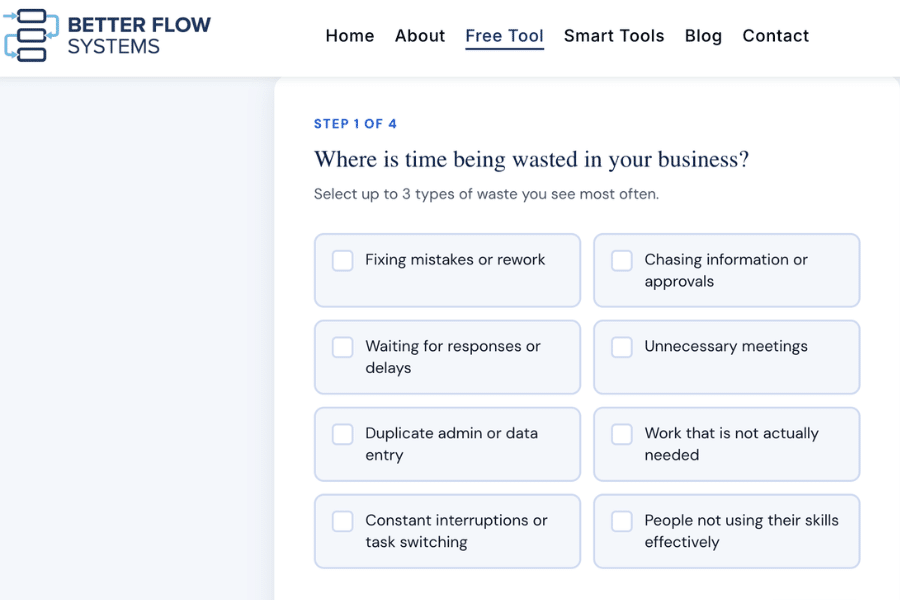
Enter your team size, your average hourly employment cost, and your estimate of daily time lost to friction. That is all it needs.
It will not tell you how to fix it. But it will tell you whether the scale of the problem justifies treating it seriously, and for most businesses that run the numbers, the answer removes any doubt.
Try it at betterflowsystems.com.
Richard Darby is the founder of Better Flow Systems and holds a Lean Six Sigma Black Belt. With 34 years of operational improvement experience across GE, British Airways, and The Nielsen Company, he now helps small and medium-sized businesses identify their bottlenecks and cut waste, without the jargon or day rates that come with large consultancies.